U.S. Labor Market Shows Mixed Signals as December Jobs Growth Slows, Unemployment Dips Slightly
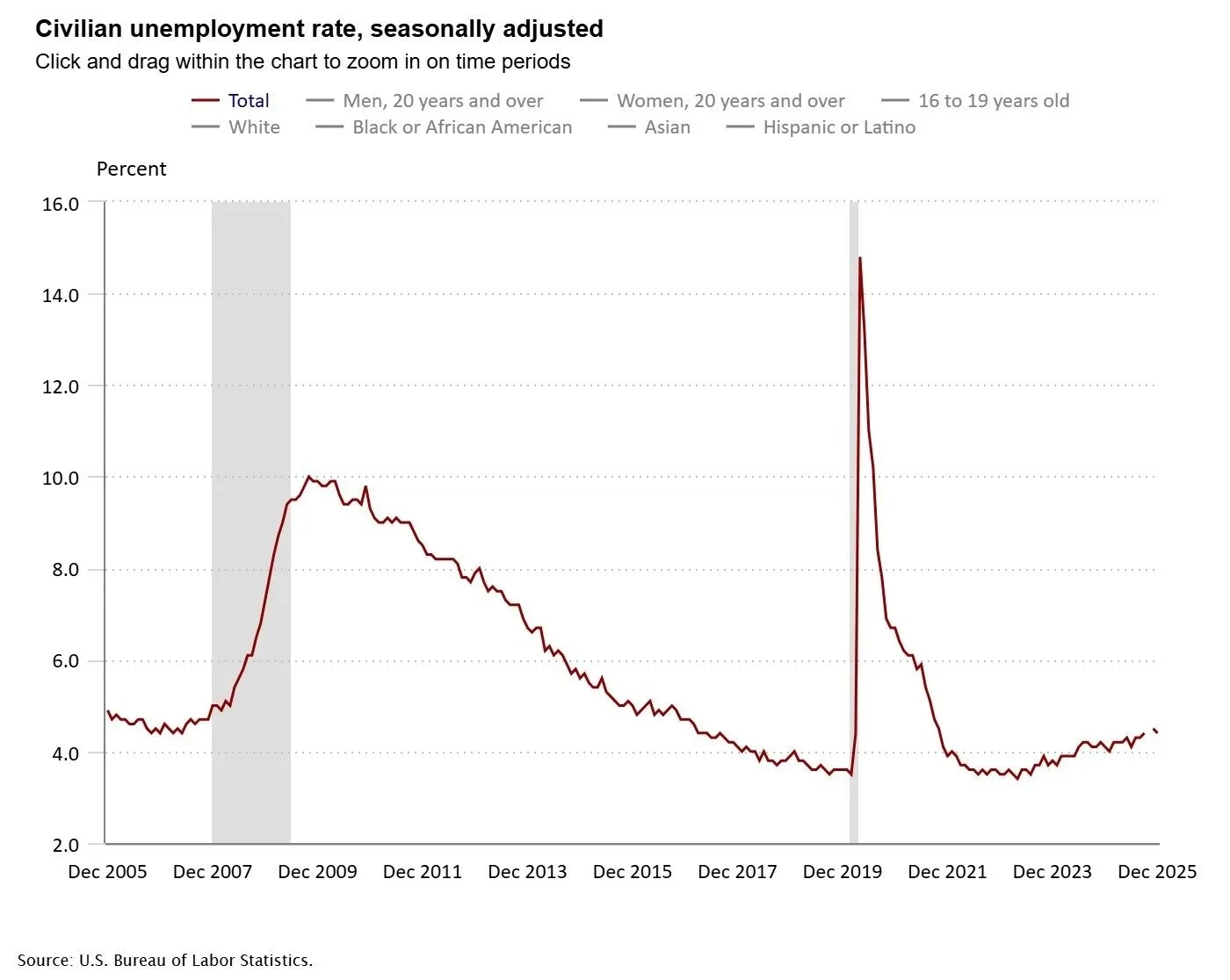

The U.S. Bureau of Labor Statistics released its Employment Situation report yesterday, revealing a subdued end to 2025 for the nation's job market. Employers added just 50,000 nonfarm payroll jobs in December, falling short of economists' expectations of around 60,000 to 73,000 new positions. This modest gain followed a downwardly revised increase of 56,000 jobs in November.


Despite the weaker-than-anticipated hiring, the unemployment rate edged down to 4.4% from a revised 4.5% the previous month, coming in slightly better than the forecasted 4.5%. The decline in the jobless rate was attributed to a drop in the number of unemployed individuals by 278,000 to 7.5 million, even as the labor force participation rate slipped marginally to 62.4%.


Job gains in December were concentrated in a handful of sectors, with notable increases in health care, social assistance, and food services and drinking places. However, losses occurred in construction, retail trade, and manufacturing, highlighting ongoing challenges in certain industries amid higher interest rates and shifting consumer spending patterns.


For the full year 2025, total nonfarm payroll employment rose by only 584,000 jobs — an average monthly gain of about 49,000 — marking the weakest annual job growth since 2003 (excluding pandemic-disrupted years). This represents a sharp slowdown from the more robust average of 168,000 monthly additions seen in 2024. Analysts pointed to factors including federal government staffing reductions (down significantly over the year) and broader "low-fire, low-hire" dynamics as contributors to the cooling labor market.


Wage growth remained resilient, with average hourly earnings rising 0.3% monthly and 3.8% annually, providing some support for consumer spending despite the hiring slowdown. A broader measure of labor underutilization (U-6), which includes discouraged workers and those employed part-time for economic reasons, also improved slightly to 8.4%.


Economists offered mixed interpretations of the data. While the dip in the unemployment rate suggested the labor market was softening gradually rather than collapsing, many warned that continued sluggish hiring could push the jobless rate higher into early 2026. The report's release has also influenced expectations for Federal Reserve policy, with some market participants now seeing a lower likelihood of near-term interest rate cuts.


Overall, yesterday's jobs report underscores a labor market transitioning toward a more balanced — yet notably slower — pace after years of post-pandemic strength. The next Employment Situation report, covering January 2026 data, is scheduled for release on February 6.